
Health Happening
The "No-Brainers" for Physical and Mental Health:
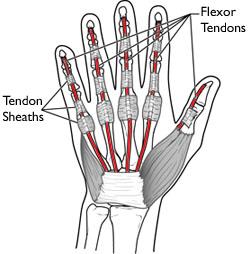
Trigger finger is a condition making it difficult to bend an affected finger or thumb as one or more of the hand's TENDONS can not move freely through the TENDON SHEATHS - the tendon can then bunch up and get "caught" in the tendon sheath "tunnel" it runs through. This can affect movement of the affected finger or thumb and can also cause the finger / thumb joints to get stuck in a bent position, which results in a painful click or pop when it straightens.
Usually affects the thumb, ring finger or little finger
Tendons are tough cords linking bone to muscle to move the bone when the muscle contracts - in the hand, tendons run along the front and back of finger bones and are attached to the muscles in the forearm.
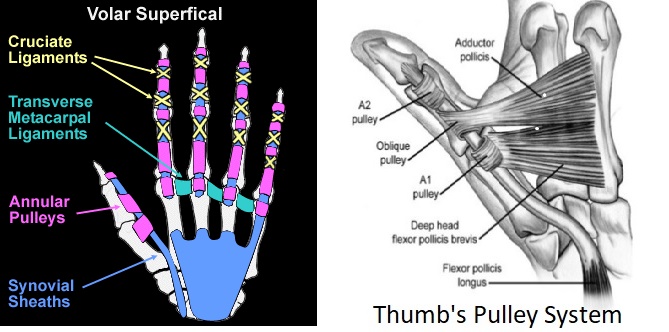
On the palm side of the hand, the flexor tendons are held close to the finger bones by ligaments called Annular or A pulleys, which arch over the synovial flexor tendon sheath (see diagram below) - the A-pulleys (together with cruciate ligaments) form a continous tunnel through which the flexor tendons pass. The protective synovial flexor tendon sheath produces a little fluid to keep the flexor tendons lubricated, enabling them to move freely within the sheath when the fingers are bent and straightened.
Fingers have 4 or 5 A pulleys and 3 cruciate ligaments. The thumb has 3 A pulleys and one oblique pulley. The first annular pulley (A1 pulley) lies near the head of the metacarpal bone (in line with the knuckles).
Trigger finger occurs if a tendon can not easily move through its pulley at the base of the finger / thumb (i.e. at the knuckle) - the tendon can then bunch up to form a small lump (nodule) making it difficult to bend the affected finger or thumb. Straightening the finger or thumb unbunches and releases the tendon causing a painful click. Pain is also experienced as either the tendon or sheath become inflamed, which produces swelling that reduces free movement. Whether the inflammation is the origin or result of the problem has not yet been determined.
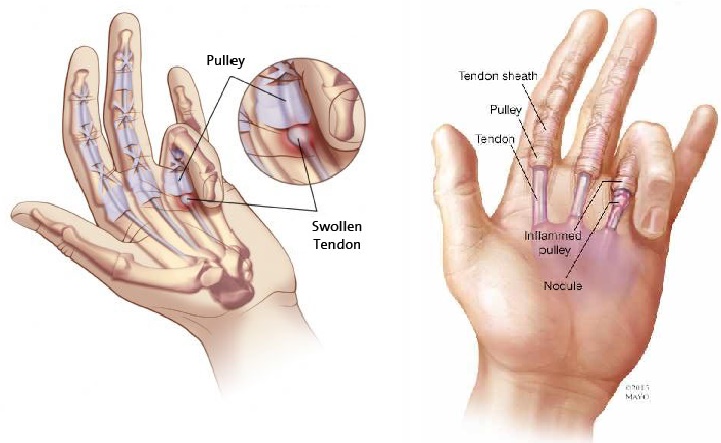
Exactly what precipitates trigger finger is unknown, but several factors may increase its development:
• Being female
• Being > 40 years of age
• Having certain medical conditions - such as Dupuytren's contracture (thickening connective tissue thickens in the hands's palm causes finger(s) to bend towards palm), diabetes, gout, rheumatoid arthritis, carpal tunnel, and being on kidney dialysis. With these conditions, trigger finger will be just one symptom added to others associated with the condition. Note that trigger finger is not necessarily accompanied by these conditions.
• Overuse of tools pressing into palm - e.g. a screwdriver
Symptoms can include:
- A nodule/bump at the base of the affected finger / thumb and pain when you move it or press at the base
- Stiffness or clicking when you move the affected finger or thumb - especially first thing in the morning.
- As condition progresses, finger/thumb may get stuck in a bent position - and then "pop" (sometimes painfully) when it straightens, which may lead you to think that the problem is in the middle knuckle of the finger or thumb joint where it pops. Instead, however, the problem lies where the tendon that moves these joints is sticking in the A1 pulley at the base of the finger or thumb (see causes). Eventually it may not be possible to fully bend or straighten the finger/thumb.
• Trigger finger may right itself without treatment. Especially in children. However, if not treated, affected finger/thumb may also become permanently bent, therefore it is advisable to apply some of the following tactics:
• Try not to use affected thumb / finger(s). Allows healing to take place;
• Splinting - reduce movement by strapping affected finger/thumb to a stiff splint
• Reduce inflammation - using short and long-term anti-inflammatory treatments
Treatments for acute inflammation
Treatments for chronic (long-term) inflammation
- Using Pulsed Electromagnetic Field (PEMF) Therapy is particularly effective - apply field (E.g. using SOTA magnetic pulser) to painful / inflamed A1 pulley area in line with knuckles;
• Massage A1 pulley on palm side of hand at base of affected finger or thumb
• Accupuncture
• Corticosteroid injections - injected into affected tendon sheath; restores movement in days/weeks; effect may not be permanent, especially in those with underlying issues, such as rheumatoid arthritis and diabetes.
• Outpatient surgery on the affected sheath - to release tendon and allow it to move freely again. Recovery time usually takes 1-2 weeks.
- One procedure involves making a small incision at base of finger to release constricted A1 pulley by cutting tendon sheath
- A more recent, less-invasive method uses ultrasound and moves a strong needle and your finger around to break apart the constriction
Possible side effects in both methods - include damage to blood vessels and nerves, and a minor risk that tendon separates from bone, which can make it difficult to fully extend finger.