Health Happening
The "No-Brainers" for Physical and Mental Health:
Retinoids are a group of cell-signaling molecules, derived from Vitamin A - Specific retinoids directly control proliferation of sebaceous glands and sebum production. In addition to its anti-aging properties, retinoids (particularly retinol and retinoic acid) used on skin have been shown to be effective in the treatment of acne by:
- Diminishing sebum production
- May reduce the number of open and closed comedones (black heads and white heads).
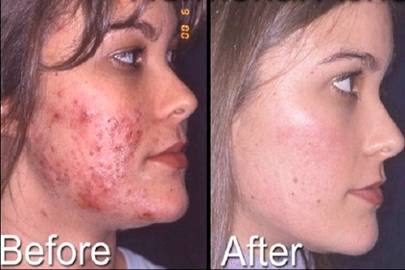
Reduction of acne after Retinoid use
- E.g. Accutane (isotretinoin) - is a powerful anti-acne, retinoid drug. Accutane molecules bind to specialized receptors on the surface of sebocyte cells causing them to slow down their growth and sebum production.Note that Accutane is categorized as a category X drug, meaning it is 100% guaranteed to cause birth defects if used by a pregnant woman. Also the FDA reported that Accutane is associated with depression, aggression and even suicide. The makers of Accutane removed it from the US market in 2009 after paying millions of dollars in lawsuit damages.However, isotretinoin is still produced and available under numerous names by a wide range of generic pharmaceutical companies (E.g. as Amnesteem, Isotane, Sotret, Oratane and Roaccutane).
Estrogens (female sex hormones) - estrogens usually antagonize (i.e. suppress) the effects of androgen hormones. This relationship partially explains why acne symptoms tend to change over the course of a woman's menstrual cycles, or during /after pregnancy. Men produce very few estrogen hormones. Estrogens may also directly affect sebaceous gland activity.
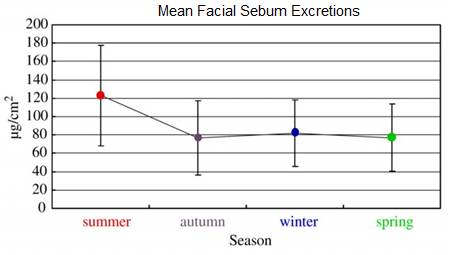
Seasonal Variations in Mean Facial Sebum Excretions
Sebum excretion higher in the summer, but acne symptoms are toned down - higher summer sebum levelsmay be due to the increased fluidity of sebum in warmer conditions. Acne sufferers tend to observe an improvement in their acne symptoms during the summer, although this may be more directly related to factors such as UV light or stress levels than to sebum production.
Stress does NOT affect sebum production - although research finds a direct correlation between stress and increased acne symptoms, stress does not appear to increase the levels of sebum production. This means that even though stress can modulate hormone levels, such as CORTISOL, it does not appear that these pathways directly impact sebaceous gland activity.
Androgens (Male sex hormones - e.g. DHEA, Testosterone, DHT, 5-ANDROSTENEDIOL) - stimulate the proliferation of sebaceous gland and sebum production;
Androgens are produced (under the influence of the pituitary gland) by the ovaries in females, the testes in men and the andrenal gland by both sexes - pilosebaceous units in the skin possess all thesteroid metabolizing enzymes (such as Type 1 5a-reductase) needed to convert DHEA to more active forms,DHT and 5-ANDROSTENEDIOL, further increasing sebum production. Furthermore, sebocytes have thecapacity to produce their own androgens from cholesterol, thus exercising local control over sebum production;
What conditions elevate androgen levels ?
▲ Puberty/adolescence
▲ Using anabolic steroids
Blood sugar roller coaster ride aggravates acne
▲ LOW blood sugar level or fluctuating blood sugar from eating too many low-fiber/high-starch carbs - a dipping blood glucose level invokes an emergency response for the adrenals to signal the liver to release some of its glycogen stores, to bring back up the blood
Androgen levels decrease with age - and thus sebum production decreases with age in both men and women.In women,sebum reduces substantially after menopause.
INSULIN-LIKE GROWTH FACTOR (IGF-1) - High IGF-1 levels correlate with elevated sebum production. IGF-1 is a protein hormone produced in the liver, similar in structure to INSULIN.
What raises IGF-1?
▲HUMAN GROWTH HORMONE (hGH) stimulatesIGF-1 hormone production - hGH levels tend to be highest during adolescence (the growing years).
▲ Milk consumption is linked to Increased IGF-1
Elevated INSULIN levels could also cause increased sebum production - since INSULIN is similar in structure to IGF-1;
▲ INSULIN levels are often elevated in individuals who consume a high glycemic diet (high sugar/carbohydrate), or who have Type 2 diabetes - chronically high INSULIN resistance and T2d, offering an explanation for the observed correlation between high glycemic diets, obesity and increased incidence of acne vulgaris.
Inflammation / Increased sebum production - in a reinforcing feedback loop, trapped sebum in a clogged follicle provides an environment conducive for bacterial infection, which causes inflammation as it feeds on sebum, which increases sebum production to provide more food for bacteria.