Health Happening
The "No-Brainers" for Physical and Mental Health:
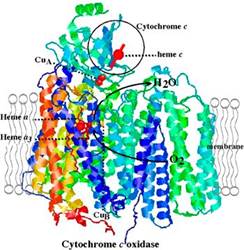
- Some bacteria (one-celled organisms) can use aerobic respiratory mechanisms to produce energy from glucose and oxygen, some cannot - the deciding factor is whether or not a bacterium contains a large protein complex cytochrome c oxidase (also called COMPLEX IV or just oxidase) in its membrane (referred to as being OX+ or OX-).
- Without cytochrome c oxidase in its membrane, a bacterium cannot survive in the presence of oxygen - oxidase is the last (terminal) enzyme in the respiratory electron transport chain (ETC) required to "harvest" electrons from glucose using oxygen for efficient ATP energy production.
| Oxidase is essential for aerobic respiration |
|---|
|
Oxidase catalyzes oxygen's oxidation of the last molecule in the electron transport chain (ETC) to water - By reducing 1 molecule of oxygen to 2 molecules of water, oxidase translocates 4 protons across the membrane to establish a transmembrane potential difference used by ATP synthase to make ATP). |
| Oxidase Negative (Ox-) | Oxidase Positive (Ox+) |
|---|---|
|
Enterobacteriae (E.g. Escherichia, Shigella, Salmonella, Proteus) |
Pseudomonas VibrioNeisseria Campylobacter(E.g. C. jejuni Helicobacter (E.g. H. Pylori) Legionella |
Oxidase+ (OX+) or Oxidase- (OX-)? - an oxidase test determines whether a bacterium produces cytochrome c oxidase and thus can use respiratory mechanism to efficiently produce energy from glucose using oxygen. Bacteria are OX+ if they contain cytochrome c oxidase. OX- bacteria can not use aerobic respiratory metabolism and are unable to live in the presence of oxygen.
A bacteria's response to oxygen (or other oxidizers) depends on the presence and distribution of certain enzymes to protect them from damage by oxidation (removal of electrons) - these enzymes react with and neutralize potentially damaging ROS (E.g. Hydrogen peroxide (H2O2), Superoxide Radical (O2.-)) generated by:
(a) Bacterial cells in the presence of oxygen and other oxidizers (E.g. ozone, chlorine, chlorine dioxide)
Or
(b) Aerobic cells due to the incomplete reduction of oxygen
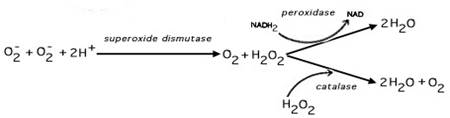
Superoxide dismutase (SOD) enzyme prevents accumulation of potentially lethal superoxide(O2.-) in aerobes and Aerotolerant Anaerobes. All organisms capable of living in the presence ofO2 necessarily contain SOD (regardless of whether they utilize oxygen in their metabolism)
2H++ 2 O2- - ==> H2O2 +O2
Nearly all organisms contain CAT, which catalyzes the decomposition of hydrogen peroxide (H2O2) to water
2 H2O2- ==> 2 H2O+O2
• Catalase-positive pathogenic bacteria make catalase to deactivate peroxide radicals. Thus allowing these bacteria to survive unharmed within the host.
Srinivasa Rao PS, Yamada Y, Leung KY (September 2003). "A major catalase (KatB) that is required for resistance to H2O2 and phagocyte-mediated killing in Edwardsiella tarda". Microbiology (Reading, Engl.)149(Pt 9): 2635-2644.
| Catalase-POSITIVE Bacteria | Catalase-NEGATIVE Bacteria |
|---|---|
|
Staphylococci Micrococci List eria Corynebacterium diphtheriae, Burkholderia cepacia The Enterobacteriaceae family (Citrobacter, E. coli, Enterobacter, Klebsiella, Shigella, Yersinia, Proteus, Salmonella, Serratia, Pseudomonas), Mycobacterium tuberculosis, Legionella pneumophila, Campylobacter jejuni,
|
Streptococcus |
• Certain aerotolerant bacteria (E.g. lactic acid bacteria such as L. Acidophilus) lack CAT - but can still decompose H2O2 by means of GPx enzymes which reduce peroxide to H2O
Reduces peroxide to H2O utilizing the body's major in-house antioxidant glutathione
2GSH (Glutathione) + H2O2→GS-SG (Glutathione Disulfide) + 2H2O
Obligate anaerobes usually lack enzymes to remove toxic by-products restricting them to an oxygen-free environment.
Obligate anaerobes lack or have low levelsof SOD, CAT and/or GPxallowing oxygen radicals to persist when exposed to oxygen or other oxidizers. These radicals inactivate other bacterial enzyme systems leading to lethal oxidations of these bacteria.
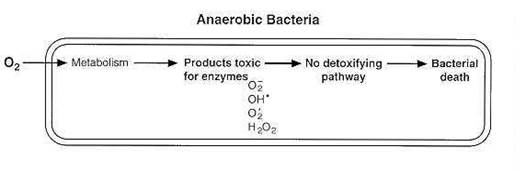
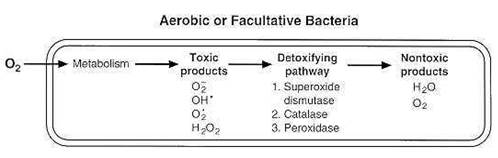
Aerobic or facultative anaerobic bacteria contain SOD, CAT or GPx,which can detoxify oxygen radicals produced in the presence of oxygen - converting them to harmless oxygen and water
| Distribution of SOD, CAT and GPx in proKaryotes with different O2 tolerances | |||
|---|---|---|---|
| Group | Superoxide dismutase (SOD) | Catalase (CAT) | Glutathione Peroxidase (GPx) |
|
Obligate aerobes and most facultative anaerobes (e.g. Enterics) |
+ |
+ |
|
|
Most aerotolerant anaerobes (e.g. Streptococci) |
+ |
- |
+ |
|
Obligate anaerobes (e.g. Clostridia, Methanogens, Bacteroides) |
- |
|
- |