
Health Happening
The "No-Brainers" for Physical and Mental Health:

 (2) ELIMINATE
CANCER CELLS
(2) ELIMINATE
CANCER CELLS



1-2-3 Cancer Treatment Plan
 |
Oleander "Soup" (Extract) ProtocolSTAGE IV / ADVANCED Cancer (NOT fast-growing) |
Therapy is potent enough to kill cancer cells but not harm healthy cells
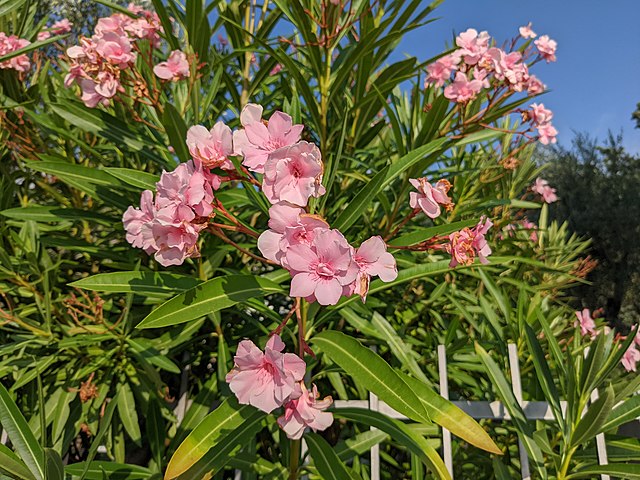
Not really a soup, but rather a diluted extract of oleander for oral or topical use can be made following instructions from Tony Isaac's book: "Cancer's Natural Enemy". (also posted on curezone.org). What you make is essentially the same as the patented medicine ANVIRZEL®. However due to the potential hazards of handling and preparing oleander leaves, you should only choose to make this recipe if you are unable to obtain the oleander capsules in the TONY ISAACS OLEANDER PROTOCOL
This remedy should be used with other immune-boosting and disease fighting supplements
It can be an adjunct therapy with prescription medications, chemo and radiation for those who decide to use them. Added to chemo or radiation oleander either eliminates or greatly lessens virtually all of the side effects associated with such treatments, including hair loss (except if using Cisplatin chemo drug).
Oleander's effects on cancer are multifold:
Those with heart conditions or high blood pressure should only use oleander soup with medical supervision.
This is an extract that acts like digitalis, which makes your heart work harder.
Begin slowly, with small amounts, increasing slowly as your system adapts. Begin with ¼ to ½ of a teaspoon two or three times a day after meals, work up slowly, building up tolerance in your stomach and digestive systems, a week at a time, until you reach 1 tablespoon three times a day after meals. The dosage level varies with individual's body weight, tolerance and side effects. Stay in your "comfort zone"
Duration of Dosage. Typical treatment times are 2-3 months; after gaining control of the cancer, you need to ensure it does not return. Continuation of smaller maintenance dosages should be considered for at least a further 3 months while you work on restoring your immune system.
Prevention / Maintenance Dosage. One regular dose three times a week (one Tablespoon) . It's easy to make, costs almost nothing (if you live in the south) .Sudies support it's long term usage boosts the immune system, helps prevent many diseases, targets and kills bad cells and ONLY bad cells..
Available at: www.curezone.org/forums/am.asp?i=910445
WARNING: THE OLEANDER PLANT AND ALL OF IT'S PARTS, IN RAW, UNCOOKED FORM IS POISONOUS AND TOXIC TO ALL LIVING ANIMALS. IF INGESTED, EVEN A SMALL AMOUNT OF THE RAW MATERIAL CAN CAUSE DEATH.
FOLLOW THE DIRECTIONS FOR COOKING THE PLANT MATERIAL EXACTLY, COOKING IT IN BOILING WATER FOR AT LEAST FOUR (4) HOURS, STRAINING THE CONCENTRATE EXTRACT AT ROOM TEMPERATURE AFTERWARDS.
WHEN CUTTING FRESH OLEANDER PLANT, DO NOT ALLOW THE SAP TO CONTACT EXPOSED SKIN. IT IS TOXIC AND WILL PENETRATE YOUR SKIN. WASH WITH WATER IMMEDIATELY IF ACCIDENTAL CONTACT OCCURS.
SEEK IMMEDIATE MEDICAL attentionIF RAW OLEANDER IS INGESTED. WEAR RUBBER GLOVES WHEN CUTTING AND HANDLING OLEANDER. WASH THE GLOVES IN WATER AND SOAP AFTER USE. FAILURE TO FOLLOW THIS WARNING CAN RESULT IN SERIOUS INJURY OR DEATH.
Ensure oleander shrub has not been contaminated with pesticides
Wear rubber gloves and use garden hand trimmers to trim new, vibrant growth of oleander stems and leaves 6" from tip - Any part of a healthy plant can be used, but trimming the youngest growing tips (usually on the lower part of the plant) provides maximum oleander sap and will also ensure that the plant lives on. Six inch lengths easily fit into the boiling pot.If you use a larger or a smaller pot, cut the length of the leaves an inch less than the diameter of the pot.
A standard plastic shopping bag, holds more than enough leaves and stems to make 60-ounces of the oleander extract.
Rinse. Before cooking, wash the oleander cuttings thoroughly under a water spray head. The boiling process will kill any bacteria, virus or little worms and spiders that live on the leaves; larger matter will be filtered out durinig straining.While washing, remove any dead or funky-looking matter.
Use a large porcelain or stainless steel pot. Up to 12 quarts in size, into which you stuff the trimmings to 2" from the top of the pot. Fill with spring or filtered water (not treated with chlorine or fluoride ) to the top of the trimmings. Pack the oleander down into the water and put the pot lid on, making sure the water level is at least two inches from the top, so it won't boil over. Boil at a low, steady, steaming, rolling boil, with the lid on for 3.5 to 4 hours, to keep it "cooking" without burning or boiling over. Check on the liquid level every hour and, if necessary, add water to ensure leaves are covered. Stirring is not needed.
Remove plant material with tongs or a screen ladle and discard carefully - be careful not to burn yourself. Volume remaining should be about 60 - 70% of the original liquid.
Boil this slowly again for about 2 to 3 hours - reducing the liquid again by 50%, to about 30% of original liquid.
Let this cool to room temperature, sitting covered for about two hours. This liquid should be as thick as chicken soup broth, pouring easily into a straining pot.
Strain the remainder. Strain through 4 layers of large and preferably unbleached coffee filters or filter paper using stainless steel colanders (in a pinch, one could use paper towels and plastic colanders, which are commonly available in grocery stores). Stack one on top of another with a filter (or towel) in between each.The top filter (or towel) may plug and need to be replaced.
Repeat the filtering process to avoid side effects. Using four or more layers of unbleached coffee filters. It will take a while, but the extra straining is needed to remove larger organic compounds that cause the more common, though mild, side effects. It is noted that the patented Anvirzel™ is strained through less than 4 micron filters and no side effects are reported when taken orally.
Mix the remaining liquid 50/50 with 80 proof vodka or apple cider vinegar (organic, raw, non-distilled) to extend shelf life by at least 6 months. For flavor, you may add some of your favorite pancake syrup, such as boysenberry (in moderation).
Using a funnel, pour into plastic empty water bottles with tight lids. Better still, use brown glass bottles, and REFRIGERATE. Avoid direct sunlight on the final liquid, as it will degrade in sunlight. You should have a total of around 60 fl oz. of extract
1. Slowly boil the recipe extract down to a light syrup. Condense liquid making it thicker at a less than boiling temperature.
2. Mix the final syrup with an aloe based hand cream. Using one part oleander syrup to three parts hand cream. Used regularly, Dr. Ozel's patent says this is a good topical cream for pre-cancerous skin cells, age spots, moles, and psoriasis.